A virus cannot reproduce on its own. It has to enter a living cell and borrow that cell's machinery to make more copies of itself. Understanding the steps in this life cycle helps explain why certain mutations matter, why some drugs work where they do, and what scientists mean when they say a variant enters cells "more efficiently."
The Virus Particle
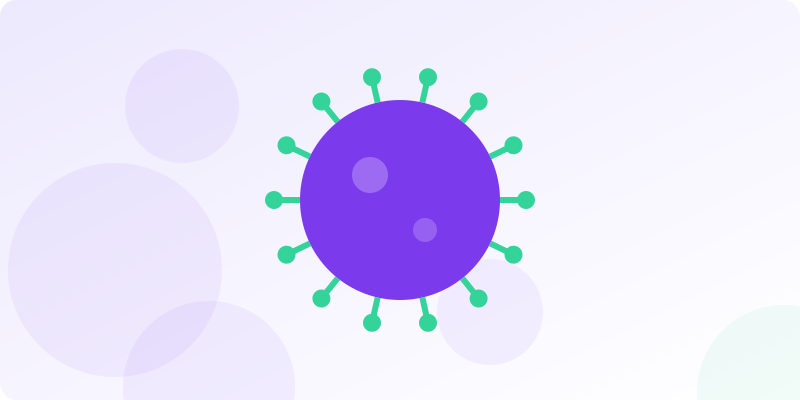
A SARS-CoV-2 particle is a tiny sphere wrapped in a fatty envelope taken from a host cell. Studded across the surface are spike proteins, which give coronaviruses their crown-like appearance under the electron microscope. Inside is the genome, a single long strand of RNA, packaged together with a nucleocapsid protein. The envelope also contains smaller membrane and envelope proteins that help hold the structure together.
Step One: Attachment
Infection begins when the spike protein meets a suitable cell, typically in the respiratory tract. The spike has two main parts. The S1 portion contains the receptor-binding domain, which latches onto a receptor called ACE2 on the surface of certain human cells. The S2 portion contains the machinery for fusing the viral envelope with a cell membrane.
Because the receptor-binding domain is both essential for attachment and a major target of antibodies, it is a hotspot for variant mutations. Changes there can alter how tightly the virus binds ACE2 and how well antibodies recognize it.
Step Two: Entry
Before the spike can drive fusion, it must be cut by host enzymes, a process called priming. SARS-CoV-2 has a site at the boundary between S1 and S2 that can be cleaved by a host enzyme called furin. A further cut can be made by enzymes such as TMPRSS2 at the cell surface or by enzymes inside compartments called endosomes.
The virus can therefore enter by two routes: fusing directly at the cell surface, or being taken into the cell and fusing from inside an endosome. Laboratory studies indicated that Omicron lineages tended to rely more on the endosomal route than earlier variants, which is one proposed explanation for differences in which cells they infect most readily.
Step Three: Translation
Once inside, the viral RNA is released into the cell. It can be read directly by the cell's ribosomes, which translate it into long chains of protein. These are then cut by viral protease enzymes into individual non-structural proteins. Together they form the replication machinery the virus needs.
One of the viral proteases involved in this cutting step is the target of some antiviral medicines, an example of how understanding the life cycle guides drug design.
Step Four: Replication and Transcription
The non-structural proteins remodel the cell's internal membranes into protected compartments where the virus copies its genome. The RNA-dependent RNA polymerase makes new full-length genomes and shorter RNA messages that code for the structural proteins, including spike. A proofreading enzyme corrects some errors along the way, but not all, which is the ultimate source of new mutations. Our explainer on how mutations arise covers this in more depth.
The polymerase is another important drug target, since blocking it halts the production of new genomes.
Step Five: Assembly and Release
Structural proteins are produced and inserted into internal membranes of the cell. New genomes, bundled with nucleocapsid protein, are packaged into budding particles. The newly formed viruses travel through the cell's secretory pathways and are released to infect neighboring cells or to be exhaled and potentially reach another person.
How the Body Responds
Infected cells raise alarms through innate immune signals such as interferons. The virus has proteins that interfere with some of these signals, which is part of why it can replicate efficiently early in infection. Later, antibodies can block attachment and entry, while T cells recognize and eliminate infected cells. More on this appears in our article on the immune response to Omicron.
Where Variants Change the Story
Most attention goes to spike mutations, because they affect attachment, entry and antibody recognition. But variants also carry changes in other proteins that can influence replication speed, immune evasion inside the cell, and how much virus is produced. The life cycle offers a framework for understanding why a mutation in one place might matter more than a mutation in another.
Key takeaways
- The spike protein binds ACE2 and is primed by host enzymes before fusion.
- Viral RNA is translated into proteins that build replication machinery.
- The viral polymerase copies the genome, occasionally introducing mutations.
- Several life-cycle steps are targets for antiviral drugs and the immune system.
Educational information only, not medical advice. For questions about testing, vaccination or treatment, follow the advice of a qualified healthcare professional and your local public health authority; in an emergency call your local emergency number.